
Mountains, desert, and sea… Sinai has much more to offer than most people imagine. The High Mountain Region, with its religious and historical importance, orchard gardening tradition, and unique nature, is unlike anywhere else in the world. The desert is every bit as beautiful as those elsewhere in the Middle East and North Africa, and within a relatively small area you will find an amazing variety of landscapes. The coral reefs of the Gulf of Aqaba are internationally recognised among the best in the world, while a number of coastal protectorates and their different ecosystems offer peaceful escapes from the resort towns.
Map of South Sinai
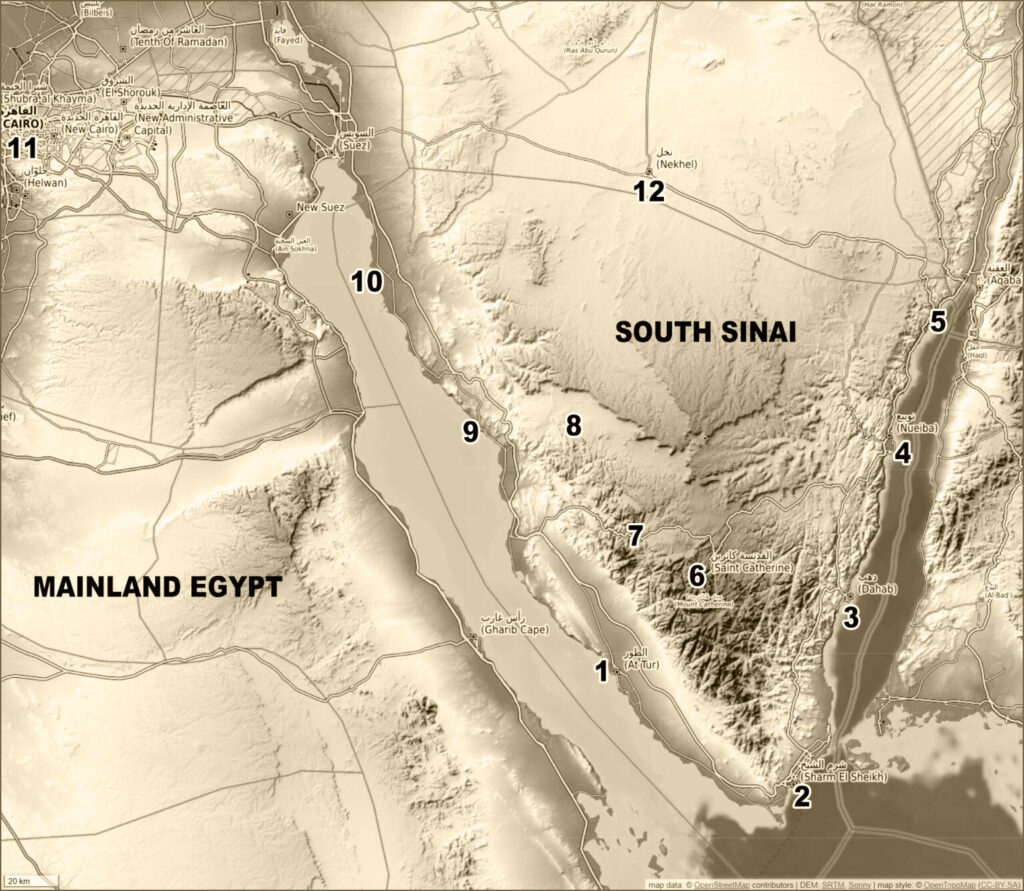
Sinai is divided into two governorates: North Sinai Governorate and South Sinai Governorate. The administrative border runs roughly along the route from the Ahmed Hamdy Tunnel to Taba, although the Bedouin traditionally place the divide further south along the edge of the Tih Plateau. Much of North Sinai is restricted for foreigners, but the vast majority of attractions are located in South Sinai anyway, which is generally peaceful and laid back.
The capital of South Sinai Governorate is El Tur (1), although the largest and most developed city is Sharm el-Sheikh (2). Another popular destination is Dahab (3), a smaller and more relaxed town attracting mostly independent travellers. In Nuweiba (4), the gateway to Jordan, and further north along the coast towards Taba (5), there are many simple beach camps offering huts directly by the sea. Beyond Taba lies the border crossing to Israel.
In the centre of the mountainous interior is the town of Saint Catherine (6), famous for Mount Sinai and St Catherine’s Monastery. Wadi Feiran (7) and Serabit el Khadem (8) are smaller settlements with important historical and archaeological sites. The coastal town of Abu Zenima (9) is a small settlement with a few shops and cafeterias, from where transport can be arranged to Serabit el Khadem. Ras Sudr (10), further north, is a seaside destination popular with visitors from Cairo.
The road connects through the Ahmed Hamdy Tunnel beneath the Suez Canal to Suez and Cairo (11), and from there another road continues towards North Sinai. A second road, once part of the ancient caravan route used by pilgrims travelling from Cairo to Mecca, cuts across the peninsula through the interior at Nakhla (12) before reaching the Gulf of Aqaba.
Egypt is one of the most populous African countries, but the Sinai Peninsula, located across the Suez Canal in Asia, is its least populated region. It is a very harsh desert environment, home to Bedouin tribes. Most are settled these days, but many still maintain a semi-nomadic lifestyle. Today you find bigger urban centres around the coast, some relying on tourism, as in the south, others on oil and gas as in the west, and on the wetter Mediterranean north coast on agriculture and trade. North and South Sinai are actually two separate governorates, with the political border more or less corresponding to the road that cuts across the peninsula from Taba to Suez. There are also clear geographical and cultural lines. The Bedouin mark the border at the edge of the Tih Plateau: to north and south, it’s two different tribal federations. The Tih Plateau is a vast eroded slope gently descending to the north; it has, and North Sinai in general, no touristic significance, apart from the views from the edge to the south. The land to the south is a very diverse and spectacular desert and mountainous landscape – that’s where all the trekking and safari routes are found. The Bedouin used to be guides even before tourism started, guiding and providing camels for pilgrims and trading caravans. For the Bedouin this is the real safari, the long desert journey on camel. Otherwise the word comes from the Arabic “safer”, which simply means travel. In our usage safari means a tour on either camel or by 4×4, a more recent innovation, while trekking is only on foot. Camel safari and trekking routes, more or less, are the same, although sometimes camels have to go a slightly different way to overcome obstacles. The 4×4 routes connect to many of the same attractions that you can reach on foot, but often via a very different way. On this website and in the guidebook you’ll find all the main routes and other relevant information.
Cities, towns, settlements
The coastal resort cities, such as Sharm el Sheikh, are well known, and most people heard of St Katherine – although not all realise it is actually a town, not only the Monastery alone. On this website some other, even smaller, settlements are also included, as they are relevant for different reasons from a visitor’s perspective.

Sharm el Sheikh: Sharm el Sheikh is a sprawling resort city at the tip of the peninsula and most visitors to Sinai arrive through its airport. Mostly noted for water sports and the wide selection of high-end hotels, the city now stretches over 20 kilometres from the port in the south to the Nabq Protectorate fence in the north. For many visitors off-road adventure means quad-biking on the outskirts of the city, but there are several good operators in town who run proper safaris.

Dahab: Livelier and more developed than Nuweiba, Dahab is the second resort city of South Sinai, but it is more human-scale than Sharm el Sheikh. Apart from excellent diving and other types of water sport it offers a few hikes, most notably in Wadi el Beda and Wadi Gnai. You could also reach the Abu Galum Protectorate on foot from the nearby Blue Hole.

Nuweiba: Nuweiba is a major port city, connecting Egypt to Jordan at their port of Aqaba. The city is spread out with four major hubs: the Muzeina village, Port (Mina), Centre and Tarabin village. Often considered part of Nuweiba, the coast to the resort town of Taba in the north is lined with simple beach camps and it is a pleasantly undeveloped sea shore. Wadi Watir is the main route inland to the Tarabin areas and also to Suez and Cairo. The city is also connected off-road to Jebel Mileihis via Wadi Saada.

Taba: The northernmost resort town on the Gulf of Aqaba, Taba is a popular holiday destination. It is also the border town with Israel, and you could also take a ferry to Jordan. Apart from the resorts and sea, and a casino, there is not much to see and do in this area, with the only exception being Pharaoh Island, a nice day-programme just off the coast. Along the coast, towards Nuweiba, there are many simple camps with huts on the beach, offering an alternative to the upmarket hotels.

St. Katherine: The town of St. Katherine is famous for the Monastery of St. Katherine, built on the site of the Burning Bush at the foot of Mt. Sinai (Jebel Musa). This is the only site most tourists visit in the interior, so it can get crowded. The best way to avoid the crowds, at least on Mt. Sinai, is to go for the sunset instead of the sunrise and descend to town before total darkness sets in. A wide range of accommodation is available in town, from simple camps to up-market hotels. A new ecolodge, called Mount Sina Eclodge, has also opened its doors near town in Wadi Isbaiya.

Sheikh Awad: The settlement of Sheikh Awad is mostly known for its ecolodge – Al- Karm was the first such place. It lies where the high mountains and the plains meet. Popular with Caireens on long weekends, it is indeed a beautiful place. With an offroad vehicle it can be approached via Wadi Islaf from Wadi Feiran, or from Tarfa village. A good place to relax, it offers treks to nearby Nabataean ruins or the seasonal waterfall at Sida Nogra. The foot pass, known as Naqb el Hawa, starts at the tomb of Sheikh Awad, connecting the settlement to St. Katherine – in the past this was the main pilgrims’ route.

Wadi Feiran: The main sights in Wadi Feiran is its Convent. The functioning, newer complex is in a beautiful garden on the main road, right next to older ruins. Opposite is Jebel Tahoun, with several hermit caves at its base and the ruins of a church on top. The view from there is dominated by towering Jebel Serbal, possibly the most beautiful mountain in the Sinai. It was believed in early ages to be the true Mt. Sinai. A guesthouse in the Convent and a couple of beautiful Bedouin gardens a bit further on along the road provide accommodation. Wadi Feiran is a very long settlement, with the centre, Markez Feiran, in the middle at an open plain.

El Tur: Although it is the capital of the Governorate of South Sinai, El Tur is quite small. It features a central market and a few shopping streets around it. Foreigners usually visit it only to renew visas, but the town does have some charm and a couple of sights. The old town at the port consists of a few neglected and fenced off buildings and another few in better conditions. They are beautiful but need some effort to be saved. There is also a hot spring in El Tur, known as Hamam Musa.

Abu Zenima: Abu Zenima is a very little town on the coast along the main Cairo- Sharm road with a few shops, cafés, restaurants and possibly basic accommodation. (You find more places to stay bit north of town towards Ras Sudr.) An asphalt road branches off from the main road just outside town in the south, the way to Serabit el Khadim. This is the shortest and easiest route from the coast, although some parts are not paved. You can organise a 4×4 vehicle with Sheikh Barakat’s family at their office in the Desert Falcon Restaurant, and possibly at the other cafés.

Serabit el Khadim: Seabit el Khadim is a settlement in the desert, where the archaeological site of a Pharaonic temple and turquoise mines are found. The family of Sheikh Salim Barakat runs a camp and organises treks and safaris further into the desert.

Ras Sudr: Located on the Gulf of Suez, on the Cairo- Sharm road shortly after the Tunnel, it is a popular holiday spot for Caireens, Egyptian and ex-pat. The town itself is a simple little place with few shops, cafes and restaurants – places to stay are mostly on the coast to the south. The area is known for its wind and windsurfing is a popular activity. Apart from these few beach resorts, there is not much else to do in Ras Sudr itself, but local Bedouin operators can organise safaris into the desert.
The Bedouin
The traditional inhabitants of the Sinai are Bedouin tribes who settled at different times in the last 1500 years. They are mostly from the Arab peninsula, with the Jabaleya a unique exception, being partly the descendants of people from the Balkan. Traditionally there are seven Bedouin tribes in South Sinai – the Tawara federation – but some other tribes from the north have moved in more recently. The Bedouin are pastoralist nomads, although most are now settled in or around towns. They still maintain a strong link to the desert and mountains, and many families move out to their campgrounds or gardens at certain times of the year. The Bedouin way of life is very simple and slow, with a fine balance of work and leisure time. It is a closed society where a complex system of family ties and traditions play the most important roles, but the people are genuinely welcoming and friendly. Having guests is an important part of the Bedouin culture, and visitors are treated as guests. It is a real experience to walk with a Bedouin guide and learn from their age-old survival skills and about their culture.
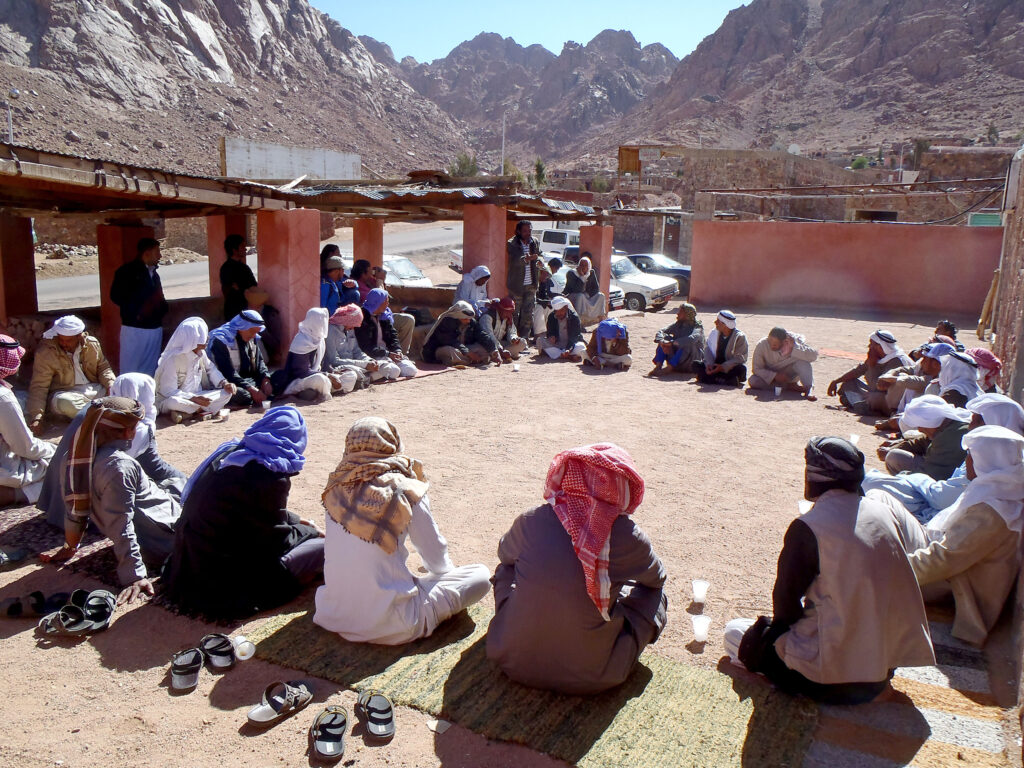
Bedouin tribal meeting. (St Catherine, February 27, 2014)
“Although life has changed in many respects and most Bedouin now live in stone houses, the arrangement of living and communal spaces still reflects life in the traditional Bedouin tent. There is always a “sitting place” for the men and the guests, locally called maqad (the general Arabic term is majlis, which also means council). It is either in one room in the house often with a separate entrance, or in the garden under a shady roof, called arisha, traditionally made of canes or palm leaves, or simply under a shady tree. Even in stone houses often a fire place is put in the middle to make/keep warm tea and coffee, which is offered to guests. Apart from the maqad in the home, small settlements have their own maqad, where matters involving the community are discussed. A maqad is always open for guests and traditionally anybody can go and sit, or even stay up to three days, in others’ maqad.” – Bedouin Life in Sinai, 2019

You find heaps more about Bedouin culture, as well as nature, history and other relevant subjects, in our suggested publications.
The Bedouin tribes of Sinai

The map of the Sinai tribes above is based on several maps and the South Sinai area is on own research. It is displayed over a Google Earth image, and the clearly visible geographical features make it easier to redraw the boundaries of the tribal territories. However, they can never be totally accurate for different reasons. Read on to learn why and to see how a map evolves.
Available maps of the Sinai Bedouin tribes

One of the first maps of the Sinai Bedouin tribes is found in Antonin Jaussen’s 1908 book titled “Coutumes des Arabes au pays de Moab“. The map shows most of the Sinai Peninsula, plus the Negev, Palestine (Israel), the Moab region in Jordan and the Hejaz in Saudi Arabia, with some of the ethnic groups marked. In the southern part of the Sinai the population is named as “Arab et-Towarah”, which is actually a historic federation of seven tribes: in my spelling Tuwara, the tribes of el-Tur. Among other Sinai Bedouin groups the Haweitat, Tarabin (Terabin) and Tiyaha (Tiaha) are also marked. Note, the Tarabin tribe is only marked in the north, in the area around Nuweiba where today they also have a land the Ayada (Aiaideh), another North Sinai tribe, is shown. All in all, it’s not a very accurate map, but it gives a general overview of the distribution of the Bedouin tribes at the beginning of the 20th century.

A much more accurate and detailed map was published in the 1951 book of another Frenchman, J. Daumas, “La péninsule du Sinaï”. It is probably the first ever touring guide covering the region, supplemented with many very detailed maps. The map of the Bedouin tribes, based on the work of G. W. Murray, marks the territory of most Sinai Bedouin tribal groups, although there are some inaccuracies: for example one of the oldest South Sinai tribes, the Bani Wasil, is not marked. The territory of the Ulad Said (Aoulad Said) tribe is also not accurate, at least if we consider how it is laid out today – perhaps back in those days it was different. Otherwise the Ulad Said, Qararsha and Suwalha (Sawalha) were one tribe at one point, which, with the addition of the Awarma, is clearly marked on the map of the Egyptian Environmental Affairs Agency (EEAA). This map is definitely an updated version of Daumas’s work, although wasn’t everything corrected. Note, according to these maps the Tarabin have a land around Nuweiba, but not around Ras Sudr.

A more recent map by Clinton Bailey, created in 1991, doesn’t outline exact tribal boundaries but gives a quite good picture of the distribution of the tribes. The territories of the Jabaleya (Jabaliyah) and Ulad Said (Awlad Said) tribes are not too clear, but you can see they are positioned as on the earlier maps. On the other hand the land of the Bani Wasil tribe around El Tur is now marked, as well as some other tribes, and on this map the Tarabin also have a land around Ras Sudr which is as today. Bailey’s 2004 book, “A Culture of Desert Survival: Bedouin Proverbs from Sinai and the Negev“, is a wonderful account of Bedouin culture and gives a good overview of the history of the Bedouin tribes in the Sinai Peninsula, as explained on Wilderness Ventures Egypt‘s site.

In an academic work of a different type, Rudolf de Jong presents one of the most accurate maps of the Arab tribes in the Sinai. It was created in 2009 and is based on Clinton Bailey’s map, but it more clearly marks the Bedouin tribal territories. The map is published in a 2011 linguistic book titled “A Grammar of the Bedouin Dialects of Central and Southern Sinai“. Clearly de Jong’s map was used in the 2012 report “Sinai: A New Front” by Ehud Yaari, with corrections and updates shown over a geographical map. However, in these works too the Jabaleya, Ulad Said and Muzeina territories are not marked as you find them today. The land of the Ulad Said tribe extends further to the south (the boundary is more or less along the line from Nabi Salah and the Blue Desert, through Nasb and Wadi Rahaba to Wadi Islah and then El Tur). It encircles St Catherine and the Jabaleya (Gebelieh) territory from the south, as well as from the northwest (Wadi Hebran, Wasi Islaf). The area to the northeast of St Catherine is a mixed land, as shown on Yaari’s map, although to my knowledge the Muzeina lay claim to it. Otherwise it is fairly easy to define the Jabaleya land, as it largely corresponds to the circular dyke around St Catherine. You have to keep in mind, though, that tribal territories cannot be displayed absolute accurately, as borders are disputed and change over history, territories overlap, little pockets of land can be found on other’s territory. Even what you call a tribe can be subjective: according to some accounts more than 70 tribes exist in the Sinai, but that’s probably with counting the many divisions (clans) within tribes. The Bedouin, from any group, often claim that land outside their current territory is used to be theirs, but nevertheless the unwritten tribal boundaries – remembered by wadi, well, tree and so – are respected.
The Sinai | Attractions | Trekking & Camel Routes | 4×4 Safari Circuits | Gardens | Publications