The traditional inhabitants of the Sinai are Bedouin tribes who settled at different times in the last 2000 years. They are mostly from the Arab peninsula, with the Jabaleya a unique exception, descending partly from the Balkans. The Bedouin tribes are diveded into two big groups, the northern and southern tribes. Traditionally there are seven Bedouin tribes in South Sinai – the Tawara federation – but some other tribes from the north have moved in more recently and established territories. The Bedouin were pastoralist nomads, but most are now settled in or around towns. They still maintain a strong link to the desert and mountains, and many families move out to their campgrounds or gardens at certain times of the year.
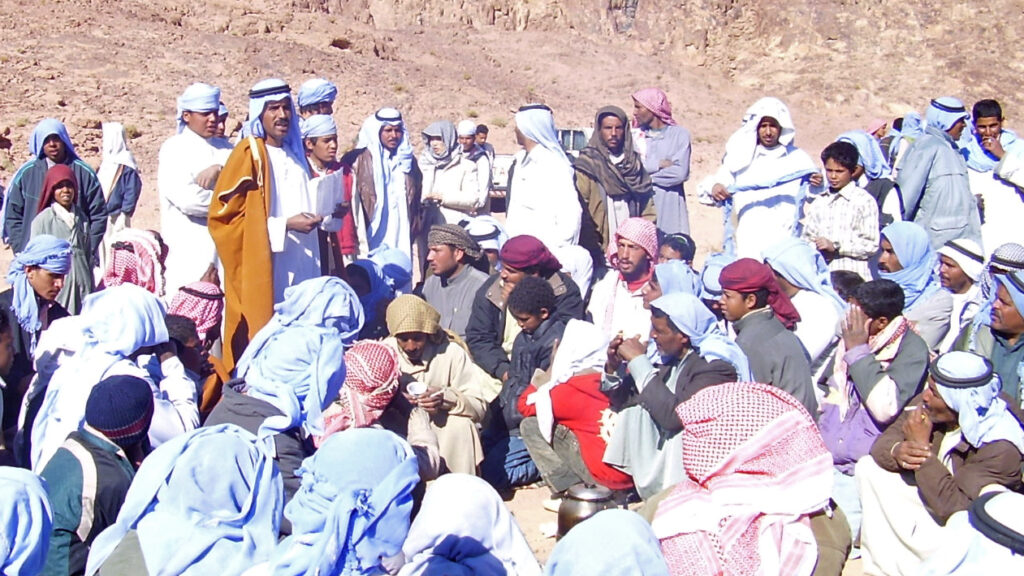
The Bedouin way of life is very simple and slow, with a fine balance of work and leisure time. It is a closed yet very welcoming society, where a complex system of family ties and strong traditions play the most important roles.
Map of Bedouin tribes in Sinai, Egypt
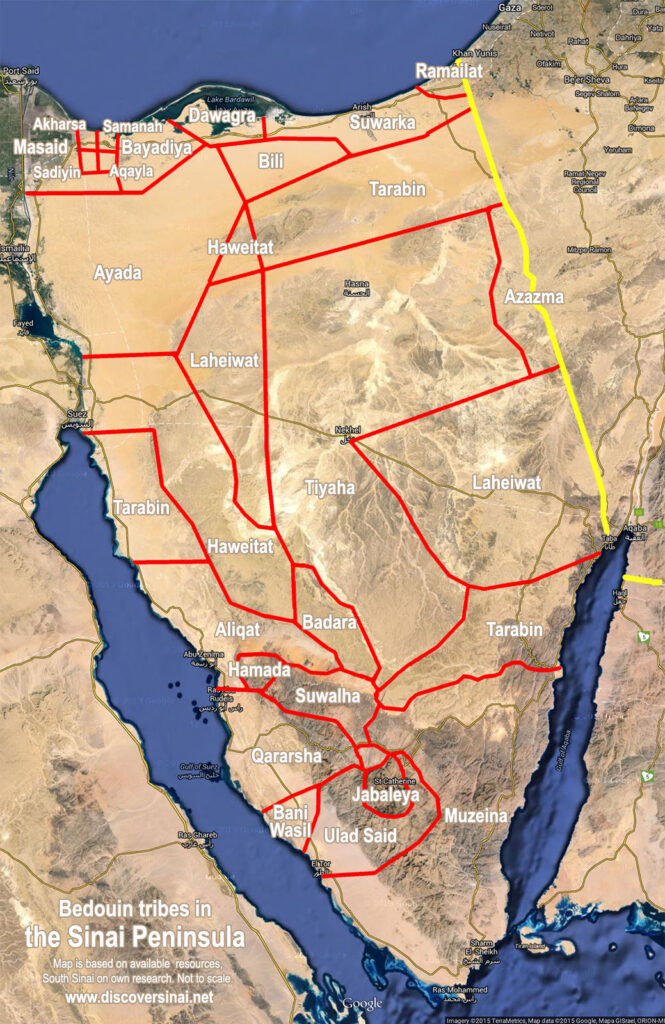
The map of the Sinai tribes above is based on several maps and own research. It is displayed over a satellite image, whose clearly visible geographical features make it easier to redraw the boundaries of tribal territories. However, they can never be completely accurate for a number of reasons: borders change and may be disputed, grazing rights may overlap, and mistakes can be made by the map creator. Therefore, use the map as a close but not perfect approximation.
Borders are well known to tribesmen, but they generally do not prevent movement of individuals or groups in the area. Grazing and water resources are available to all tribes through inter-tribal agreement. Under traditional law individuals who discover new water sources are able to settle next to it, so long as it is in their tribal area – however he would not be allowed to prohibit use of the water by others. Individuals can have the rights to exclusive cultivate an area of land, however the viability of this is dependent on the availability of the water.
The Bedouin have their unwritten law called Orf which even the Egyptian authorities accept; they tend to let internal issues be settled by the bedouin thenselves. Each law was given a specific name like “Onwa”, “Doukhl” and “Hilf”. Decisions in important matters are made at tribal gatherings called Majlis (meaning “council”, also used for the sitting room) with the participation of all and are based on consensus. At these gatherings “all might speak, but most weight attached to the words of men of recognised authority.” “The tribal shaykh is regarded as the man of authority who rests his case on his wealth, his inherited prestige, his personal capabilities in helping fellow tribe members, and-as a result of all of this-his occupying the most preeminent position in society.”
Bedouin society is a complex and closed tribal affair, but the people are genuinely welcoming and friendly. Having guests is an important part of the Bedouin culture, and visitors are treated as guests. It is a real authentic experience to walk with a Bedouin guide in the mountains or desert and learn from their age-old survival skills and about their culture.
References:
• UNDP Global Environment Facility
• Larry Roeder
• R. A. Nicholson, A Literary History of the Arabs, Cambridge 1930, 79. (W. Montgomery Watt)
• Blending Tradition and Progress in the Desert
THE SINAI: The Sinai Peninsula > The Bedouin > Transport > Safety & Security